







For jewelry wholesalers, REACH and amfori BSCI answer different questions. REACH concerns chemical restrictions for products placed on the EU market; amfori BSCI is a social due diligence and audit programme for production sites. Neither a factory audit nor a generic “compliance certificate” proves that every jewelry SKU meets every market rule. Buyers should check product evidence and factory evidence separately, against the order they are placing.
Key takeaways
- REACH evidence should match the material, components, finish and SKU being purchased, plus the intended market.
- A BSCI audit concerns a named production site and a point in time. amfori states that BSCI is not a certification.
- Ask for the full report or permitted platform access, corrective-action status, audit date and facility identity; do not rely on a logo or first-page summary.
- Use separate approval gates for chemical testing, social-risk review, sample approval and bulk-production inspection.
REACH vs. BSCI: what does each one cover?
REACH is the EU chemicals regulation (Regulation (EC) No 1907/2006). Its Annex XVII restricts certain substances in specified products and uses. For jewelry, buyers commonly need to assess nickel release and applicable lead and cadmium restrictions. The legal requirement depends on the article, material, use and market placement. Start with the REACH regulation on EUR-Lex and the ECHA list of substances restricted under REACH; confirm the current text for the specific product.
amfori BSCI, by contrast, supports social-risk management in supply chains. Its assessment concerns a production site’s working conditions and management practices, not the chemical composition of a necklace or bracelet. The amfori BSCI programme overview describes 13 Performance Areas, including workers’ involvement, fair remuneration, working hours, occupational health and safety, child labour, forced labour and ethical business behaviour.
Keep the distinction clear: a REACH test report cannot show that workers’ conditions were assessed, and a BSCI audit report cannot show that a finished earring meets a nickel-release limit. A buyer needs both kinds of evidence when both product risk and supplier social risk matter.
Which REACH checks matter for jewelry?
For nickel, REACH Annex XVII, entry 27 sets release limits for specified articles in direct and prolonged skin contact. Pierced post assemblies inserted into ears or other pierced parts of the body must release less than 0.2 µg/cm²/week. Other covered articles, such as bracelets, rings, chains and necklaces, must release less than 0.5 µg/cm²/week. These are release limits, not total nickel-content limits.
That distinction affects the test plan. An XRF screening result may indicate elemental composition, but it does not measure nickel release. For a product-specific decision, confirm the applicable method with a competent laboratory; EN 1811 is the reference test method for nickel release. Where a coating is relied on as a barrier, ask whether wear and corrosion conditioning under EN 12472 is applicable before testing. Check the actual legal text and lab advice for your SKU rather than treating a single test name as a blanket approval.
Lead and cadmium are addressed by separate REACH restrictions with their own scope and exceptions. Do not assume that a report for one metal, component or material answers every restricted-substance question. Give the lab a bill of materials that identifies the base metal, solder, plating, stones, enamel and other relevant components, and state where the finished piece will be sold. The jewelry material guide can help buyers frame material questions before requesting evidence.
How should you review a REACH report?
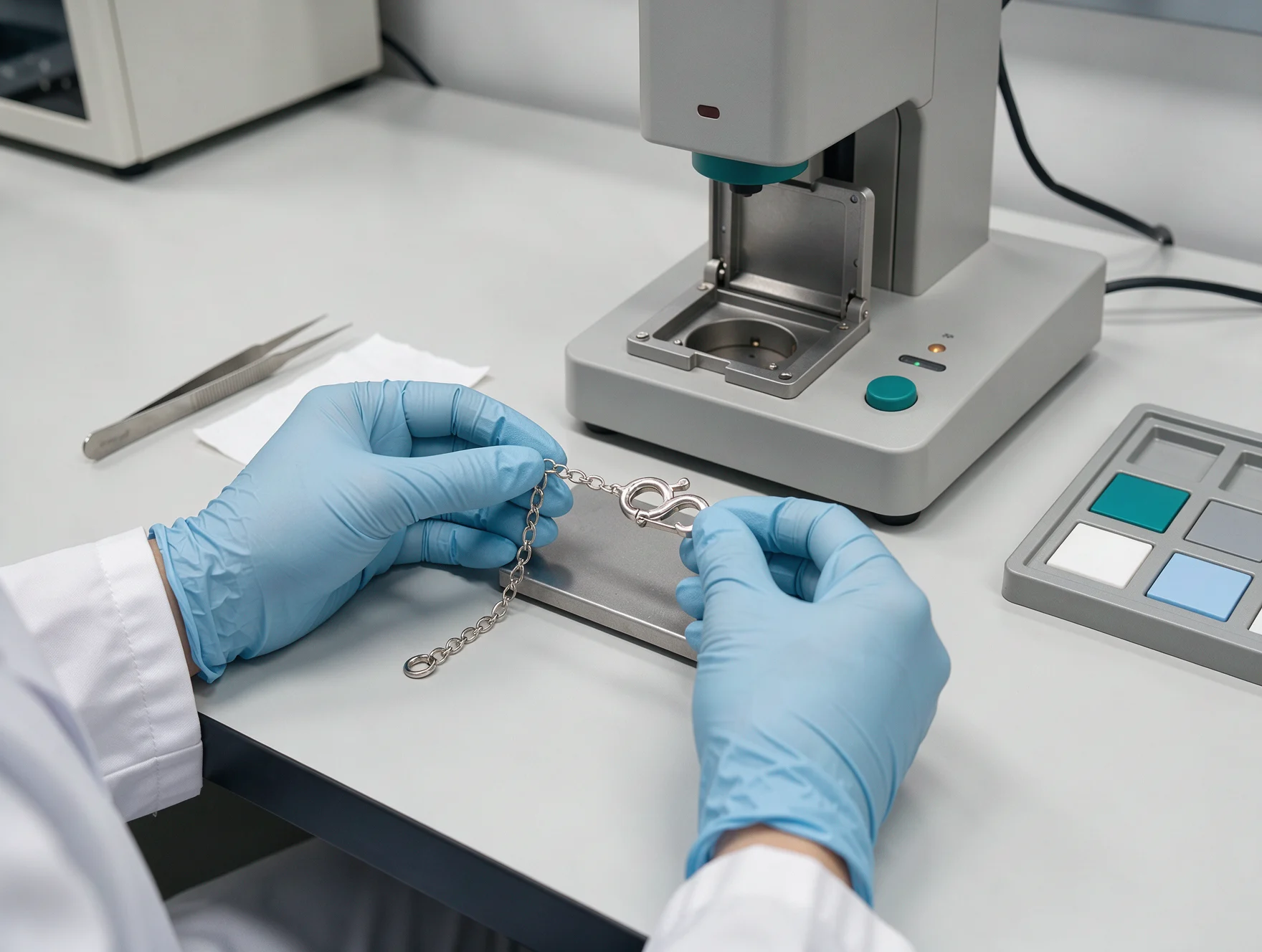
Treat a report as evidence for the sample and scope it names. Before accepting it, compare the report with your purchase specification and ask:
- Does the report identify the exact SKU, sample, batch or material tested?
- Does it name the tested components and finish, including plating or coating where relevant?
- Is the test method appropriate to the restriction and intended use?
- Who issued the report, when was it issued, and can the laboratory confirm its authenticity?
- Will production use the same material sources and process as the tested sample, and how will changes be controlled?
A “REACH certificate” is not a universal product passport. A declaration, certificate, screening result and accredited laboratory report are different documents. Read the issuer, scope, sample identification, test method, result and limitations rather than judging by the document title or a supplier’s badge.

What does a BSCI audit tell a wholesale buyer?
A BSCI assessment gives information about social conditions at the audited site at the time of assessment. amfori says BSCI is not a certification and describes audits as one tool within broader due diligence, not a guarantee that all risks are absent. Its audit process uses site observations, worker interviews and document review; the full findings are accessed through the amfori Sustainability Platform by eligible members and audited suppliers.
A report is useful only when it relates to the factory that will make or finish your order. Match the facility name and address to the supplier’s production plan. If the quoted supplier uses a subcontractor for casting, plating, stone setting or assembly, ask which sites are involved and what assessment or risk controls cover them. A trading company’s office audit does not automatically cover a separate production facility.
Review the audit date, assessment type, findings, rating where shown, and corrective-action progress. The amfori BSCI system describes a two-year audit cycle, with follow-up audits depending on the result; the cycle is not a two-year guarantee of current conditions. Ask the supplier or responsible amfori member how current findings and follow-ups apply to the site and order. For a fuller supplier assessment, see our guide to vetting a jewelry factory’s materials, process and controls.
A buyer’s evidence checklist
| Evidence | What it can help establish | What to verify |
|---|---|---|
| REACH laboratory report | Test results for named sample(s) and substances | SKU/material match, method, lab, date, scope and limitations |
| Supplier material declaration | Supplier’s stated composition for specified components | Component coverage, supporting records and change control |
| amfori BSCI audit report | Social assessment findings for a named site at a point in time | Facility identity, audit date/type, findings and corrective actions |
| Purchase specification and approved sample | The product and process the order is expected to match | Materials, finish, dimensions, components, tolerance and substitutions |
Keep these records connected: save the supplier quotation, approved sample photos, test report, audit reference, purchase order and any corrective-action commitments under the same product or order code. Our jewelry OEM manufacturing guide explains how written specifications and sample approval help control production changes.
A practical supplier-check workflow
- Define the market and product. State the destination country, intended customer and age group, SKU, materials, finish and components.
- Map the production route. Identify the legal supplier, actual manufacturing site and any subcontracted processes.
- Set a product test plan. Ask a qualified lab which restrictions and methods apply to the finished item and its components.
- Review social evidence. Request the BSCI audit reference or report access available to the supplier, and match the assessment to the site doing the work.
- Approve the production sample. Record the tested material and finish and agree that substitutions need written approval and, when relevant, updated testing.
- Recheck at reorder or change. New plating, components, production sites or material sources can change the evidence needed. Update the file before repeating the order.
Red flags that need follow-up
- A supplier calls a BSCI audit a “BSCI certificate” or promises it guarantees legal compliance.
- The audit names an office or different factory, while your order will be made elsewhere.
- A REACH document has no clear sample, scope, method, date or issuing laboratory.
- A single report is presented as covering every design, component, finish and future production batch.
- The supplier will not explain subcontracting or notify you about changes to materials and processes.
These points do not automatically prove misconduct or non-compliance. They are reasons to pause, clarify the scope, obtain suitable evidence and document the answer before placing or repeating an order.
Frequently asked questions
Is amfori BSCI a certification?
No. amfori explicitly states that BSCI is not a certification. It is a social-risk management approach that includes audits and continuous improvement. Ask for the site-specific findings and status rather than treating a logo as proof of certification.
Does a BSCI audit prove that jewelry is REACH compliant?
No. A BSCI audit addresses social conditions at a production site. REACH product restrictions require evidence relevant to the jewelry’s substances, components, finish and intended market. Review the audit and product evidence as separate checks.
Can one REACH report cover a whole jewelry collection?
Only if its scope and test plan genuinely cover the relevant products and components. Designs with different base metals, solders, coatings, stones or contact parts may need different assessments. Have the laboratory confirm the representative samples and coverage.
How often should a buyer request a new BSCI audit?
Do not decide from a fixed date alone. amfori describes a two-year cycle, but results may call for follow-up and site conditions can change. Ask the supplier or responsible member for the current audit status, corrective actions and how the assessment cycle applies to that facility.
Planning a wholesale or custom jewelry order? Share the target market, product specification and production route with your supplier before sampling. Leejory’s compliance page lists available company documents; request the current scope and validity for the specific site or product you are evaluating. You can also contact our team with your requirements.
This guide is general information, not legal advice. Requirements and document scope can change; confirm current obligations with the relevant authority, accredited laboratory or qualified compliance adviser.